



 Precision Orifices (Hydraulic Nozzles)
(Restrictors / Jets / Throttles)


1) Cleanliness
- We check 100% - no bore chips
2) Bore-size Marking
- Easy identification - anywhere & without special tools
- Less mistakes ("small" errors in hydraulics can become very expensive)

3) Precision Bore and Short Orifice Length
- Stable throttling function in varying conditions
- Less dependent on fluid viscosity (e.g. temperature)
4) Robust construction
- Please see principle cut sheet
Please see our up-to-date Datasheet/Pricelist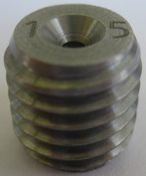
HUGE Stock --> Quick Delivery
Available types:
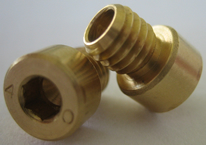
- Models
- Full-thread (set-screw type)
- Head-type (socket-screw type)
- Materials
- Steel
- Brass
- Threads
- Metric-threads (DIN 13)
- Coarse: M3 / M4 / M5 / M6 / M7 / M8 / M10 / M12
- Fine: M8x1 / M10x1 / M12x1
- Whitworth - BSPP (DIN ISO 228)
- G1/8 / G1/4 / G3/8 / G1/2 / G3/4
- Metric-threads (DIN 13)
- Hole diameters
- From: d=0,20 mm upwards
- Up to: A/F of the chosen type
- 0,05mm step intervals (below 1,0 mm)
- 0,1mm step intervals (over 1,0 mm)
Precision Orifice = Safe OEM System-Solution
During machine design phase, the optimum parameters of the hydraulic system are sought.
We help our customers in estimating suitable hole diameters - according to their hydraulic system (free of charge).
For prototyping needs we deliver orifice-kits. With an orifice-kit it is easy to try-out the exact hole diameters at the application.
During serial manufacturing phase, a precision orifice guarantees a stable throttling function.
A hydraulic nozzle with its accurate tolerances guarantees an excellent repeatability. The OEM can be sure to deliver an identical system - every time.
We deliver precision orifices - quickly and flexibly, exactly the requested quantities, even one-by-one if needed.
During field use (after delivery), the machine might end up to a far-away country, where there might be many sorts of operating conditions as well as operators.
The more sensitive or complex the system, the more important it is to cut out unnecessary adjustment parameters, that can at worst become disturbance variables. By using a hydraulic nozzle for a throttling function, the OEM eliminates the possibility of "too easy field-adjustments" by possibly unknowledgeble end-users.
When using our orifices, the restriction can only be changed by changing the orifice itself. Changes can easily be identified afterwards from the bore-size marking. System-adjustments are made systematically by known/exact step-changes.
(By comparison, many flow control valves are equipped with an adjustment screw or -knob. This might be handy if a fine-tuning possibility of the parameter at hand is required in field-use. However, if the process includes multiples of possible adjustment-parameters, it can also present a risk that an end-user makes "his own" adjustments to a delicate process and only manages to build-up further disturbance to the functioning.)